
 7 minutes
 2025-07-14
 Compliance Automation
Conflicts of interest are a common yet potentially serious issue in organisations of all sizes. Whether you’re running a small business or managing a large corporation, you need to be aware of how conflicts of interest arise, why they can be problematic, and how to address them proactively.
In this guide, we’ll explain what a conflict of interest is, go through various types of conflicts, discuss what a good conflict of interest policy should include, and illustrate best practices for managing conflicts in the workplace.
What is a Conflict of Interest?
A conflict of interest occurs when an individual’s personal interests (financial, familial, social or otherwise) have the potential to interfere with their professional obligations or decision-making on behalf of an organisation. In simpler terms, it’s a situation where someone’s private interests might make it difficult for them to act impartially in the best interest of their employer or clients.
These conflicts can be actual, as when a direct conflict is happening, potential when it could happen in the future, or perceived when it looks like a conflict to an outsider, even if technically it may not be.
In each case, personal interest (family, gifts, personal gain, relationships) could compromise professional judgement or actions. It doesn’t mean the person will act improperly, but the situation is such that it could happen or people might suspect it’s happening. That risk is what defines the different types of conflict of interest.
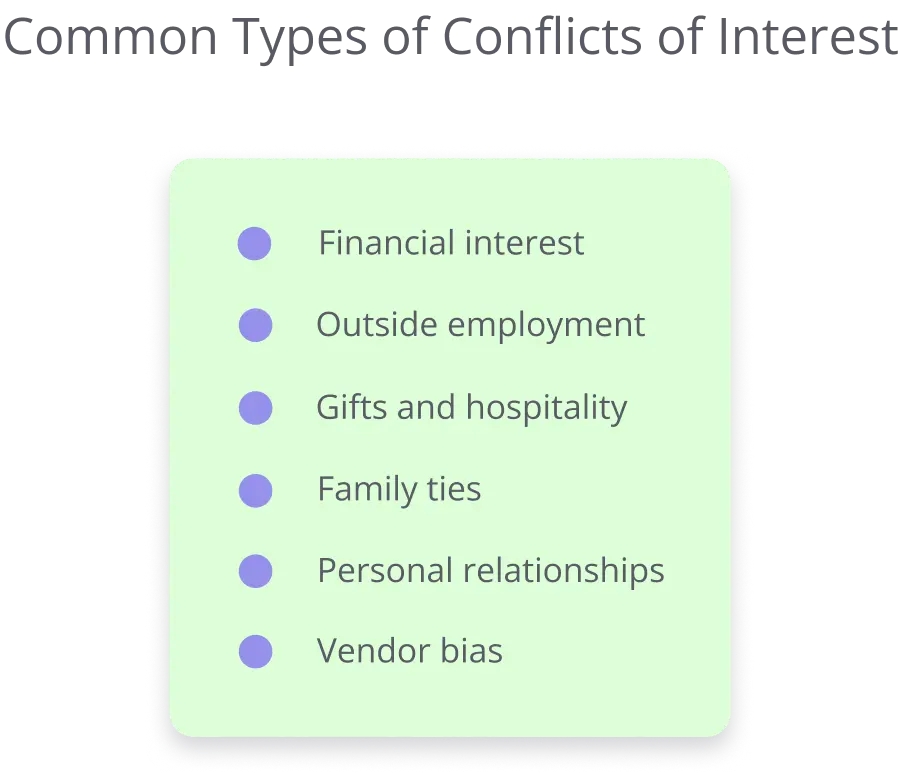
Common Types of Conflicts of Interest (with Examples)
Here are a few everyday scenarios that illustrate conflicts of interest examples that can take place in the workplace one way or another:
- A manager hires or promotes a relative, leading co-workers to suspect favouritism (nepotism).
- An employee accepts expensive gifts or hospitality from a vendor who is bidding for a contract, raising questions about whether the contract award will be biased (gift and bribery related conflict).
- An employee at a pharmaceutical firm could learn about a positive trial result before public release and purchase stock in the company (insider trading conflict).
- An employee has a second job with a competitor, or runs a side business that overlaps with the company’s business, which could influence their priorities or use of company time (outside employment conflict).
- A staff member who oversees procurement has a financial stake in one of the suppliers the company uses – their personal financial interest could conflict with their duty to get the best deal for the company (financial self-dealing / competing business conflict).
- A project lead is romantically involved with a subordinate on the team. This personal relationship could affect their judgement on evaluations or assignments, even subconsciously (personal conflict of interest).
- A board member might pressure the company to do business with a firm owned by a politician’s family, hoping to gain political favours (influence peddling).
- A manager whose misconduct was reported might have a personal interest in silencing or punishing the whistleblower, which conflicts with their duty to uphold ethics and protect employees (retaliation as a conflict).
Key Elements of a Strong Conflict of Interest Policy
When designing conflict of interest policies, the primary goal is to draft a formal document (sometimes part of the Code of Conduct) that outlines how conflicts are identified, disclosed, and managed. But what should a good conflict of interest policy include?
Definition of a Conflict of Interest
Start by clearly defining what your organisation considers a conflict of interest. Give examples of personal interests (financial interest, relationships, outside roles, gifts, etc.) that could conflict with professional duties. The clearer the definition, the easier for employees to self-identify potential conflicts. For example, “A conflict of interest arises whenever an employee’s personal, financial or other considerations might influence or appear to influence their decisions at work or ability to perform their job objectively.”
Duty to Disclose
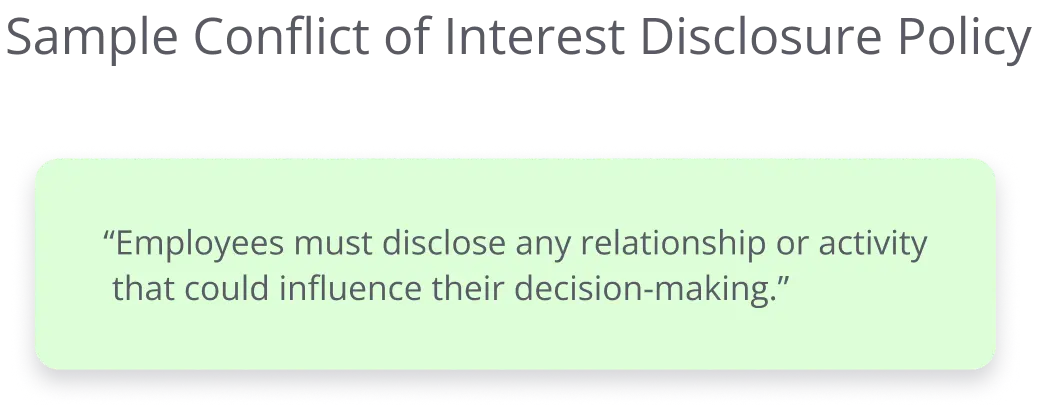
The policy must require that anyone who suspects they have a conflict must disclose it to a designated person or department. It should outline the process for disclosure such as informing a manager or HR/compliance officer in writing.
The policy should encourage prompt disclosure, and emphasize that disclosure itself is a good-faith action, so that employees know they won’t be punished just for having a potential conflict if they report it, only if they conceal or mishandle it.
Review and Decision Process
The policy should state how the organisation will review disclosed conflicts and decide on actions. Often, a compliance officer or a committee will evaluate the disclosure. The policy might outline criteria, such as severity of the conflict, potential impact, etc. It might also specify that certain trivial conflicts may be waived if deemed not harmful, whereas others will require mitigation.
Examples and Guidance
Good policies include examples to guide employees. For instance, list out scenarios: “You hire a family member -> Not allowed without disclosure and approval. You are offered a gift over X value -> must decline or get approval. You want to take on freelance work -> discuss with HR to ensure no conflict,” etc. Some policies include a FAQ style section.
Annual Disclosure Process
Many organisations incorporate an annual conflict of interest declaration for key employees or all staff. The policy can mention that on an annual basis, employees will be asked to affirm whether or not they have any conflicts. This keeps information updated. Especially for boards of directors and executives, annual disclosure forms are standard.
Non-Retaliation Clause
To encourage disclosure, mention that the company will not retaliate against anyone for reporting a conflict of interest in good faith (similar to whistleblowing protections). The fear of acknowledging a conflict (especially if it’s something like a relative in a vendor company) might make employees hide it; assuring them that transparency is valued helps.
How Logwise Helps Manage Conflicts of Interest
Navigating conflicts of interest can involve a lot of tracking and follow-up, especially as an organisation grows and the relationships multiply. This is where technology like Logwise proves invaluable. Logwise offers tools specifically designed to identify, track, and mitigate conflicts of interest, making the whole process smoother and more foolproof:
Pre-Trade Clearance System
For personal trading conflicts (like insider trading risks or employee trading policies), Logwise’s Personal Account Dealing solution facilitates the pre-clearance process for trades. It logs all trades, making it easy for compliance to audit and detect any suspicious patterns. This drastically reduces the chance of insider conflicts slipping through and provides monitoring.
Audit-Ready Documentation
With everything recorded in Logwise – disclosures, reviews, decisions, approvals, monitoring logs – the organisation is well prepared for any audit or regulatory inquiry. It becomes quick and easy to demonstrate the logs as evidence, showing the conflict of interest policy dissemination, the disclosures captured, the actions taken, and the ongoing monitoring.
Simplifying Board and Executive Conflict Tracking
Board members and executives often have many outside interests. Logwise provides a secure way for them to disclose their board seats, investments, etc., and for the corporate secretary or compliance to keep a live register. Before each board meeting, one can quickly review that register to see if any agenda items might intersect with a declared interest – and remind the relevant director to recuse if so.
User-Friendly Reminders
From the employee perspective, Logwise makes compliance simpler. Instead of remembering to email HR about their new side gig, they might get a gentle prompt from the system to update any conflicts of interest if their situation changes. If an annual disclosure is due, the platform sends reminders. This helps employees help the company stay conflict-free.
Conclusion
Conflicts of interest are an inherent risk in any organisation due to the simple fact that people have lives and interests outside of work. But with clear policies, a culture that encourages transparency, and robust tools like Logwise to support the process, these conflicts can be managed effectively.
Book a demo to learn how Logwise makes conflict disclosures easy and auditable.

EU Listing Act – Implications for MAR and Insider Lists
 Compliance Regulations & Updates
The Act was published 14 November 2024 and entered into force on 4 December 2024. Its changes to MAR are rolled out in two waves, with three different effective dates: 4 December […]
 7 min
7 min May 27, 2026
 EU Listing Act – Implications for MAR and Insider Lists
The Act was published 14 November 2024 and entered into force on 4 December 2024. Its changes to MAR are rolled out in two waves, with three different effective dates: 4 December […]
 4 minMay 27, 2026
 EU Listing Act – Implications for MAR and Insider Lists – 4 December 2024
The Act was published 14 November 2024 and entered into force on 4 December 2024. Its changes to MAR are rolled out in two waves, with two different effective dates: 4 December […]
 3 minMay 27, 2026
 Revised Conditions for Delaying Disclosure
The delay mechanism (under Art. 17(4)) is retained, but one of the three conditions has been amended. The previous condition – that delay is “not likely to mislead the public” – is […]
 4 minMay 27, 2026
 Protracted Processes: Disclosure Only on the Final Event
Under the pre-June 2026 rules: Issuers have been required to disclose inside information arising at each intermediate step of a protracted process (such as e.g. ongoing merger negotiations, a capital raise, or […]