
 6 minutes
 2025-07-14
 Compliance Automation
Financial market regulations are essential for safeguarding market integrity and ensuring transparent business practices. Among these, the disclosure obligations for Persons Discharging Managerial Responsibilities (PDMRs) are critical in ensuring fair trading practices.
But what is a PDMR, and why is compliance with PDMR disclosure requirements so important? Let’s explore the key aspects of PDMR obligations, including their scope, the role of closely associated individuals (PCAs), best practices for ensuring compliance, and real-world examples illustrating the importance of adhering to these requirements.
What Is PDMR?
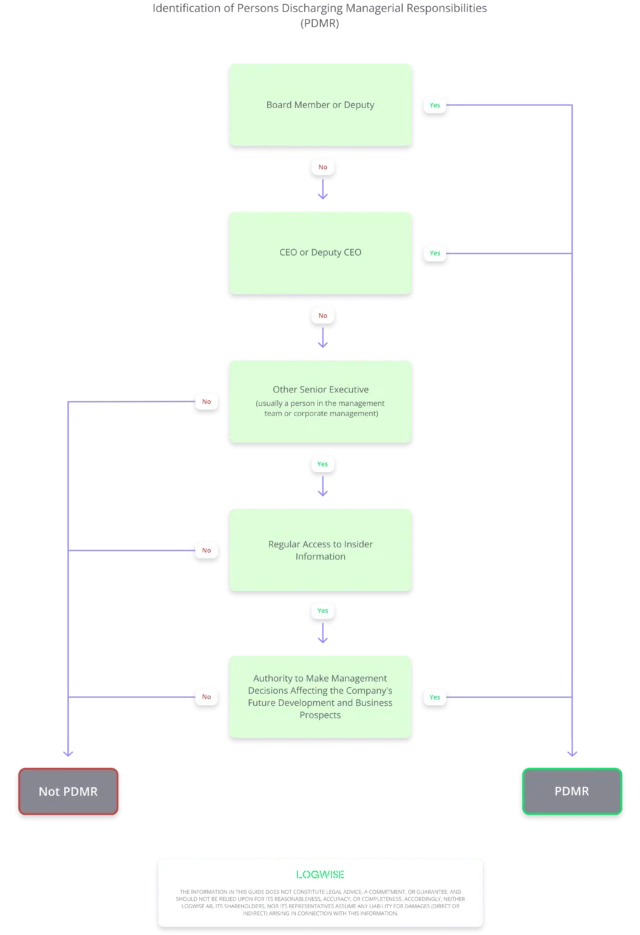
A PDMR is defined, both in the EU and the UK, as a person within a company with managerial responsibilities that give them regular access to sensitive information about the organisation. Examples include board members, senior executives, or directors whose positions enable them to influence company decisions.
Identifying PDMRs is essential because they may have access to insider information. As individuals who play key roles in shaping company strategy and operations, their transactions are subject to scrutiny under the Market Abuse Regulation (MAR).
Formal PDMR Appointment
A formal PDMR appointment occurs when an individual assumes a position of managerial responsibility within a company. This process typically involves documentation specifying their duties’ scope and obligations. Companies must ensure that the newly appointed PDMR is informed of their obligations under MAR, including disclosure responsibilities and the potential penalties for non-compliance.
A formal appointment process should include training sessions for new PDMRs, detailing the specific requirements for reporting their financial activities and those of their PCAs. These sessions should occur annually, covering topics such as identifying reportable transactions, understanding regulatory deadlines, and effectively communicating with legal counsels.
What Are PDMR Disclosure Requirements?
PDMR disclosure requirements are a set of obligations that ensure transparency regarding the trading activities of PDMRs and their PCAs. These requirements are designed to prevent market abuse and maintain investor confidence.
Key Elements of Disclosure Requirements
- Notification of Transactions
- PDMRs must report their dealings in company securities, including the purchase, sale, or transfer of shares, bonds, or other financial instruments tied to the company.
- To promote market transparency, companies must disclose these transactions to the public within a specific timeframe (typically three business days in the EU).
- Scope of Transactions
- PDMR dealings extend beyond direct transactions by the PDMRs themselves. They also include activities carried out by PCAs.
- Transactions must be reported, regardless of size, upon reaching the threshold outlined in the national legislation, as even small trades can influence market perceptions. For example, a small trade by a PDMR might signal insider knowledge to other market participants, potentially triggering larger market movements or speculation about the company’s future performance. This comprehensive reporting minimises the risk of information asymmetry in the market.
- Role of PCAs
- PCAs (persons closely associated) include immediate family members, spouses, or other individuals whose financial activities could be linked to the PDMR. They also include legal persons, such as companies controlled or owned by the PDMR or associated PCAs.
- PCAs are obligated to disclose their dealings in company securities. Companies should have mechanisms in place to educate PCAs about their responsibilities. This could include formal notifications and easy-to-understand guidelines to ensure awareness.
Example of a PCA Disclosure
If a director’s spouse purchases shares in the company, this transaction must be disclosed as it falls under the PDMR disclosure requirements. Failure to report such activities can result in penalties for both the PDMR and the PCA.
Why Are PDMR Disclosure Requirements Important?
Adherence to PDMR disclosure requirements is critical for several reasons:
- Market Integrity
- Transparency in PDMR dealings builds trust among investors and stakeholders.
- It ensures that all market participants operate on a level playing field, reducing the risk of insider trading.
- Market integrity safeguards the company’s reputation and long-term viability.
- Regulatory Compliance
- Non-compliance with PDMR obligations can result in severe penalties, including fines and reputational damage.
- Companies that fail to adhere to these requirements may face scrutiny from regulatory bodies.
- Adherence demonstrates a proactive approach to governance and accountability.
- Investor Confidence
- Clear and timely disclosures reassure investors about the fairness and integrity of the market.
- It can positively impact stakeholder relationships.
How to Ensure Compliance with PDMR Disclosure Requirements
Adhering to the PDMR disclosure requirements can be challenging. However, companies can implement the following measures to streamline compliance:
1. Establish Clear Policies
- Develop and maintain a comprehensive insider trading policy that outlines PDMR dealings and disclosure obligations.
- Include guidance on the role of PCAs and their responsibilities under MAR.
- Ensure that these policies are accessible and regularly updated to reflect any regulatory changes.
2. Leverage Compliance Software
- Utilise tools like those offered by Logwise to identify and list PDMRs and PCAs as well as tracking transactions and holdings.
- Automated systems can flag potential non-compliance and simplify the reporting process.
- Advanced features, such as AI-driven analysis, can detect patterns that might indicate risks or non-compliance.
3. Educate PDMRs and PCAs
- Conduct regular training sessions to ensure PDMRs and their PCAs know their obligations, such as the closed period which involves a ban on PDMR trading 30 days ahead of the release of financial reports. Logwise’s PDMR solutions support sending notifications before the closed period.
- Provide examples of compliant and non-compliant behaviours to clarify expectations.
- Create engaging training materials to enhance understanding, including case studies and interactive sessions.
4. Timely Reporting
- Ensure that all transactions are disclosed within the regulatory timeframe.
- Assign dedicated personnel to oversee the reporting process and liaise with regulatory authorities.
- Implement a pre-notification system to ensure PCAs are reminded of their responsibilities.
5. Monitor Compliance Regularly
- Regularly audit the processes related to PDMR disclosures to identify and address potential gaps.
- Establish a feedback loop for continuous improvement, leveraging insights from audits and training sessions.
PDMR Dealings: Common Challenges
Despite best efforts, companies often encounter challenges in managing PDMR dealings. Addressing these challenges is crucial for maintaining compliance, avoiding regulatory penalties, and preserving the company’s reputation in a highly scrutinised market environment. They include:
- Delays in Reporting
- PDMRs or PCAs may fail to promptly notify the company of their transactions, leading to late disclosures.
- Late reporting can result in fines and heightened scrutiny from regulators.
- Inadequate Awareness
- Some PCAs may not fully understand their obligations, resulting in unintentional non-compliance.
- Companies must bridge this gap through comprehensive communication and education initiatives.
- Complex Transactions
- Structured transactions, such as derivatives or employee stock options, may complicate the reporting process.
- Companies need specialised tools and expertise to handle these complexities effectively.
Addressing these challenges requires a proactive approach, including robust training programs, advanced monitoring tools, and clear communication channels.
Conclusion
Understanding and adhering to PDMR disclosure requirements is essential for companies seeking to maintain market integrity and regulatory compliance. By clarifying what a PDMR is, emphasising the role of formal PDMR appointments, and highlighting the significance of PCAs, organisations can better manage their obligations under MAR.

EU Listing Act – Implications for MAR and Insider Lists
 Compliance Regulations & Updates
The Act was published 14 November 2024 and entered into force on 4 December 2024. Its changes to MAR are rolled out in two waves, with three different effective dates: 4 December […]
 7 min
7 min May 27, 2026
 EU Listing Act – Implications for MAR and Insider Lists
The Act was published 14 November 2024 and entered into force on 4 December 2024. Its changes to MAR are rolled out in two waves, with three different effective dates: 4 December […]
 4 minMay 27, 2026
 EU Listing Act – Implications for MAR and Insider Lists – 4 December 2024
The Act was published 14 November 2024 and entered into force on 4 December 2024. Its changes to MAR are rolled out in two waves, with two different effective dates: 4 December […]
 3 minMay 27, 2026
 Revised Conditions for Delaying Disclosure
The delay mechanism (under Art. 17(4)) is retained, but one of the three conditions has been amended. The previous condition – that delay is “not likely to mislead the public” – is […]
 4 minMay 27, 2026
 Protracted Processes: Disclosure Only on the Final Event
Under the pre-June 2026 rules: Issuers have been required to disclose inside information arising at each intermediate step of a protracted process (such as e.g. ongoing merger negotiations, a capital raise, or […]