
 11 minutes
 2025-07-14
 Compliance Automation
Developing and managing strong compliance policies is key for any company that aims to meet regulatory obligations while eliminating the myriad of risks involved. Without these policies, businesses can easily become overwhelmed by complex regulations, which can lead to inconsistent practices and increased exposure to legal, financial, and reputational damage.
By creating a robust structure enforced by compliance policies, managing tasks between teams, ensuring consistent decisions, promoting accountability across departments, and maintaining a solid framework for monitoring and responding to potential violations or regulatory changes is possible.
This article covers the fundamentals of compliance policies and why they are crucial for any business subject to financial regulations. It also shows how to implement, develop, and manage strong compliance policies, outlining some of the best practices for policy creation, implementation, and monitoring, ensuring compliance alignment across departments.
What Is a Compliance Management Policy
In broad terms, a set of compliance policies are specific rules and guidelines that help businesses follow a structured approach internally, making it easier and more efficient to meet any imposed regulations that might apply to that company.
Most companies start by creating two sets of compliance policies, which can be divided into internal and external guidelines. This makes it easier for individuals within the organisation to understand and work within the framework and helps ensure that both operational behaviour and regulatory requirements are addressed in a clear and organised manner.
These policies can be further segmented into different areas, such as financial policies, data protection policies, employee policies, and more, to provide a complete ruleset that addresses the overall environment and company culture while tackling specific issues and challenges.
For instance, companies might develop a code of conduct or an anti-harassment policy that applies to every employee, regardless of their position or department. Companies typically also design more specific policies, covering areas such as data protection, environmental compliance, or financial reporting, that are aimed at employees working on those specific tasks.
Why Strong and Credible Compliance Management is the Key
Building a robust compliance management system is essential for any company in regulated industries or markets, especially finance or healthcare, which tend to have stricter laws and rules. Even minor oversights can lead to significant penalties, legal action, reputational damage, and customer loss in these industries.
Meeting regulatory obligations is perhaps the most obvious reason for implementing compliance policies across any business. These policies help businesses work within complex regulatory frameworks, avoiding legal issues and negative consequences. They also help the company stay consistent across different departments, which can foster a culture of integrity across all levels of the business.
Compliance policies ensure that the company and individual employees adhere to legal regulations and laws and promote the right mindset and behaviour regarding employee conduct while managing the different risks involved with compliance and promoting a more efficient day-to-day operation. Investors, partners, and auditors also value compliance policies, which are often considered a sign of a mature and transparent company.
5 Core Elements of a Strong Compliance Policy
Understanding what makes a strong and reliable compliance policy is key to designing and implementing it. Employees must understand their obligations, the boundaries of acceptable behaviour, and the procedures they are expected to follow. A few core elements help businesses develop a solid policy, which we will discuss below.
1. Clear Purpose and Scope
Every compliance policy should clearly state its purpose early on to let the reader know the overall goal and why it is necessary to achieve it. The scope should also be defined clearly, including which departments, roles, or activities are covered by the policy, to avoid misunderstandings and ensure a smooth process.
2. Roles and Responsibilities
Depending on the size and ambitions of the organisation, specific compliance officers, department managers, or supervisors might be involved, all of whom can have different responsibilities regarding policy. Therefore, these areas should be clearly defined to ensure accountability and reduce the risk of tasks overlapping two departments.
3. Standards of Conduct and Behavior Expectations
A firm compliance policy should also involve specific expectations regarding employee behaviour and ethical conduct. This will establish a framework for how the staff should act in everyday situations and design general guidelines to help them deal with more unusual or unexpected circumstances. For instance, this can touch on conflict of interest, respectful workplace behaviour, and confidentiality.
4. Consequences for Non-Compliance
Adding a section dealing with the consequences of not complying with the framework and regulations is highly recommended. This will help ensure fairness when enforcing the policy and make it more likely that the rules are being followed in the first place. Companies can use their existing methods, such as internal warnings or disciplinary actions, or create a new set of consequences depending on the severity of the violation.
5. Continuous Review and Improvement Protocols
Finally, it is also important that the policy remains flexible and undergoes regular reviews to update any lacklustre or outdated principles based on changes to regulations or internal incidents. External audits often impact the policy based on findings or recommendations, so a compliance policy should never be considered static or completed.

Developing Compliance Policies
To develop a strong set of compliance policies, it is recommended that the process be approached systematically and the core elements fully understood. This will allow us to design the necessary elements for a comprehensive, clear, and actionable compliance policy.
This step is typically the most daunting for businesses, which is why many choose to partner with a service provider that has the expertise and experience to avoid mistakes or gaps, ensure that the policies are compliant and effective, and save internal manpower that can be used elsewhere.
Compliance Risk Assessment
One common way to begin the development process is by identifying the business’s risks regarding legal compliance. The regulatory environment is constantly evolving, the threats and chances of violations are high, and the consequences of non-compliance can be severe, ranging from financial penalties to reputational damage or even legal action.
Therefore, it is recommended that as many types of assessments of compliance risks as necessary are conducted to identify the various laws applying to the policies and how the company might be violating these regulations. This typically involves looking at past compliance issues and enforcement actions while also studying applicable regulations, such as MAR articles 17, 18, and 19 for EU-listed companies.
This allows one to understand the industry’s specific regulations, including local and international laws, and any internal standards that must be addressed. By working with compliance experts to determine which areas of the business require specific compliance policies, such as financial transactions, data protection, or health and safety, one can develop a compliance policy that covers all bases.
Define the Policy Objectives
The next step is to create a set of clear compliance objectives that ensure every individual policy and guideline aligns with the company’s internal goals while adhering to the applicable regulations. The policy should outline any desired outcomes, such as ensuring data privacy or adhering to environmental laws, so that everyone involved understands why the rules exist.
These objectives should, at minimum, include details for mitigating risk and ensuring legal compliance across all departments. However, they will often be expanded to cover accountability, company culture, and potential consequences for non-compliance to ensure that every employee understands the importance of the overall objectives.
Involve Key Stakeholders
By engaging with relevant stakeholders, such as department heads, legal teams, risk management professionals, and other compliance officers, the company can ensure that the policy reflects a realistic and comprehensive understanding of the company’s challenges and risks.
Furthermore, involving key individuals will make it more likely that the policy is practical and achievable since it will be better aligned with the specific needs of the different departments and applicable regulations. This will also foster a greater sense of ownership and accountability early on.
Develop Clear and Concise Guidelines
Now that the groundwork has been completed, the actual development of the compliance policy can begin. Every part of the policy should be written in clear language, avoiding legal jargon or technical terms, so that employees at all levels understand the full meaning and extent of the policy guidelines.
The guidelines should outline what employees are expected to do, what they should not do in different situations, and what steps to follow to ensure compliance. Examples and past situations can help illustrate and guide employees effectively, but in general, a short and concise policy is optimal to avoid overloading employees.
When developing the guidelines, it is essential to address relevant compliance topics such as data protection, financial reporting, workplace conduct, and any other specific regulations the company may be subject to as per its industry. This step can be pretty complex and will often require templates or external service providers and advisors to fully cover all the necessary areas and ensure a strong compliance policy.
Best Practices
It is one thing to define objects and design a compliance policy. Having it be an effective part of internal and external operations is another. By implementing some of the best practices related to compliance policies, businesses can achieve better results and significantly reduce non-compliance risks.
Ensure Accountability and Assign Roles
Once the compliance policy is completed, it is necessary to help onboard employees to ensure they understand their responsibilities. It is recommended that you start by defining the roles and responsibilities of compliance officers, department heads, and employees in relation to each policy.
This can be done by clearly identifying who is responsible for monitoring compliance, reporting violations, and taking corrective actions. Often, this will be handled by first training the higher levels of management and providing them with the necessary information and resources to help them effectively communicate the compliance requirements to their teams.
Monitoring and Auditing
Another important aspect of ensuring the compliance policies are working as intended is implementing a compliance monitoring policy or establishing ongoing internal audits and self-assessments. This can help identify gaps in the policies or the employees’ understanding or implementation.
Incident tracking and regular checks can be implemented to monitor compliance, ensuring
employees adhere to the policies. This allows for corrective action processes and reporting mechanisms, making it more likely that potential violations are recorded and dealt with. Internal audits can also help prevent future occurrences and recognise which parts of the policy and implementation work as intended.
The Role of Technology in Policy and Compliance Management
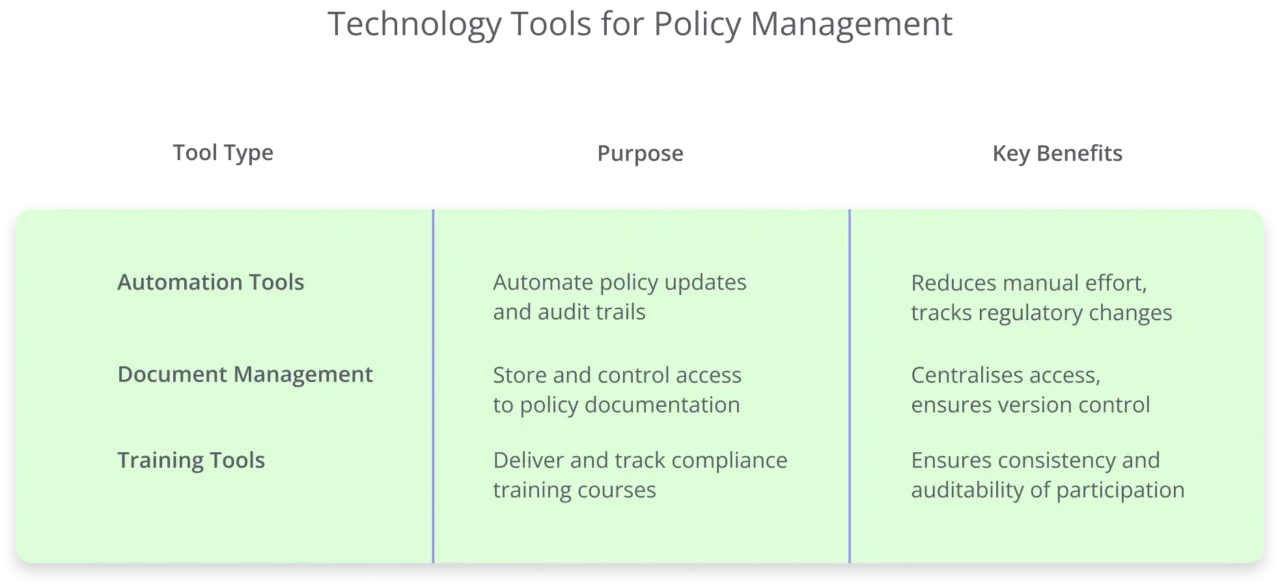
Technology provides businesses with excellent tools that can help alleviate some of the burden and workload involved with staying compliant while streamlining workflows and providing a more efficient daily operation of the company. Typically, these software solutions are customised to fit internal systems and processes and are highly flexible. However, there are still some general concepts and categories worth mentioning.
Automation Tools
Once the compliance policies have been successfully implemented, it becomes possible to automate part of the process to minimise the risk of human errors and ensure that all employees have the latest information. These tools can also track regulatory changes or generate reports for internal or external audits, saving time and money.
Document Management Tools
Storing, organising and sharing documents internally or externally can be a huge burden for larger companies, especially when it involves sensitive information. By adopting a document management solution, it becomes possible to centralise all documents in a secure, organised, and easily accessible system, allowing for different roles to access different levels of information at any time, ensuring that everyone is on the same page.
Training and Education Tools
These tools make it possible to create online training platforms where employees can participate in mandatory compliance courses and track their progress automatically. This ensures that all employees receive consistent training and that completion records are securely stored, providing an easy audit trail and a higher level of compliance.
Conclusion
Developing and managing strong compliance policies can be tedious, but they are essential for businesses and organisations that want to simplify financial regulations. By creating the right framework, using advanced technology, and working with the right compliance solution provider, regulatory risks can be significantly reduced while improving workflow and achieving a more efficient and transparent business.
Logwise helps businesses centralize, automate, and enforce compliance policies effortlessly—ensuring your company stays audit-ready and aligned with evolving regulations.
Discover how Logwise can streamline your compliance management today.

EU Listing Act – Implications for MAR and Insider Lists
 Compliance Regulations & Updates
The Act was published 14 November 2024 and entered into force on 4 December 2024. Its changes to MAR are rolled out in two waves, with three different effective dates: 4 December […]
 7 min
7 min May 27, 2026
 EU Listing Act – Implications for MAR and Insider Lists
The Act was published 14 November 2024 and entered into force on 4 December 2024. Its changes to MAR are rolled out in two waves, with three different effective dates: 4 December […]
 4 minMay 27, 2026
 EU Listing Act – Implications for MAR and Insider Lists – 4 December 2024
The Act was published 14 November 2024 and entered into force on 4 December 2024. Its changes to MAR are rolled out in two waves, with two different effective dates: 4 December […]
 3 minMay 27, 2026
 Revised Conditions for Delaying Disclosure
The delay mechanism (under Art. 17(4)) is retained, but one of the three conditions has been amended. The previous condition – that delay is “not likely to mislead the public” – is […]
 4 minMay 27, 2026
 Protracted Processes: Disclosure Only on the Final Event
Under the pre-June 2026 rules: Issuers have been required to disclose inside information arising at each intermediate step of a protracted process (such as e.g. ongoing merger negotiations, a capital raise, or […]