
 9 minutes
 2025-07-14
 Compliance Automation
Conflicts of interest at the board of directors level pose unique challenges. Board members hold significant decision-making power and fiduciary duties, yet they often have broad networks, business interests, or roles in other organisations that can create real or perceived conflicts.
In this article, we will explore why board of directors conflict of interest matters so much, common scenarios where it arises, and best practices to handle it. We’ll cover the policies and tools that help maintain integrity in the boardroom – from robust conflict of interest policies to workflows for disclosures and recusals.
Conflict of Interest Board of Directors & Why It Matters
Members of a board of directors are entrusted with steering the organisation in the best interests of its shareholders. This fiduciary duty of loyalty means directors must put the organisation’s interests above their own personal interests. When a board member’s personal interest conflicts with their duty, it can compromise decisions and expose the company to serious risks.
Regulatory and Legal Obligations
Many jurisdictions mandate that directors disclose any personal interest in transactions the company is considering, and abstain from related decisions. In the UK, the Companies Act 2006 requires directors to avoid situations where they have a direct or indirect interest that conflicts with the company’s interests, unless authorised by the other board members. Across Europe, jurisdictions have laws guiding directors towards good governance, including conflict of interest requirements.
Reputation and Stakeholder Trust
An actual or perceived board member conflict of interest can be highly damaging to the company’s reputation. News of a director profiting at the company’s expense, or influencing decisions for personal gain, can lead to public scandal, loss of investor confidence, and scrutiny by regulators. Stakeholders expect board decisions to be made objectively and in the company’s best interest.
Risk of Poor Decisions and Legal Action
From a practical standpoint, a conflicted director might lead the company into bad deals or risky arrangements. Directors can even face personal liability in some cases if they’re found to have not acted in the company’s best interest due to a conflict.
Tone at the Top
Perhaps one of the less discussed but vital reasons is the impact on corporate culture. The board sets the tone at the top for ethics and compliance. If board members are cavalier about conflicts of interest, management may adopt the same attitude. Holding directors accountable to conflict-of-interest standards helps create a culture of compliance within the company.
Common Conflict of Interest Scenarios for Board Members
Board members are often accomplished individuals involved in various enterprises and community roles. As such, it’s not uncommon for potential conflicts to arise. Here are some common scenarios of conflicts of interest on boards:
- Self-dealing and financial interests: A director may have a financial stake in a transaction the company is considering.
- Related party transactions: This is when the company is doing business with someone who is closely related to a director..
- Multiple board seats: A conflict can arise if two companies have intersecting interests. Antitrust law even forbids certain interlocking directorates in competing companies due to conflict of interest and anti-competitive concerns.
- Perceived conflicts through relationships: Sometimes, conflicts can arise due to divided loyalty because of personal relationships which can take many different shapes.
- Corporate opportunities: The duty of loyalty generally says directors shouldn’t appropriate a corporate opportunity for themselves and always put the company before their own gains.
- Structural conflicts: Occasionally, conflicts come from organizational roles. Many corporate governance best practices (like separating CEO and Chair roles) are aimed at reducing these structural conflicts.
- Competitor affiliations: If a board member is affiliated with a competitor, that’s a glaring conflict. They have access to sensitive information and strategy of your company and of the competitor.
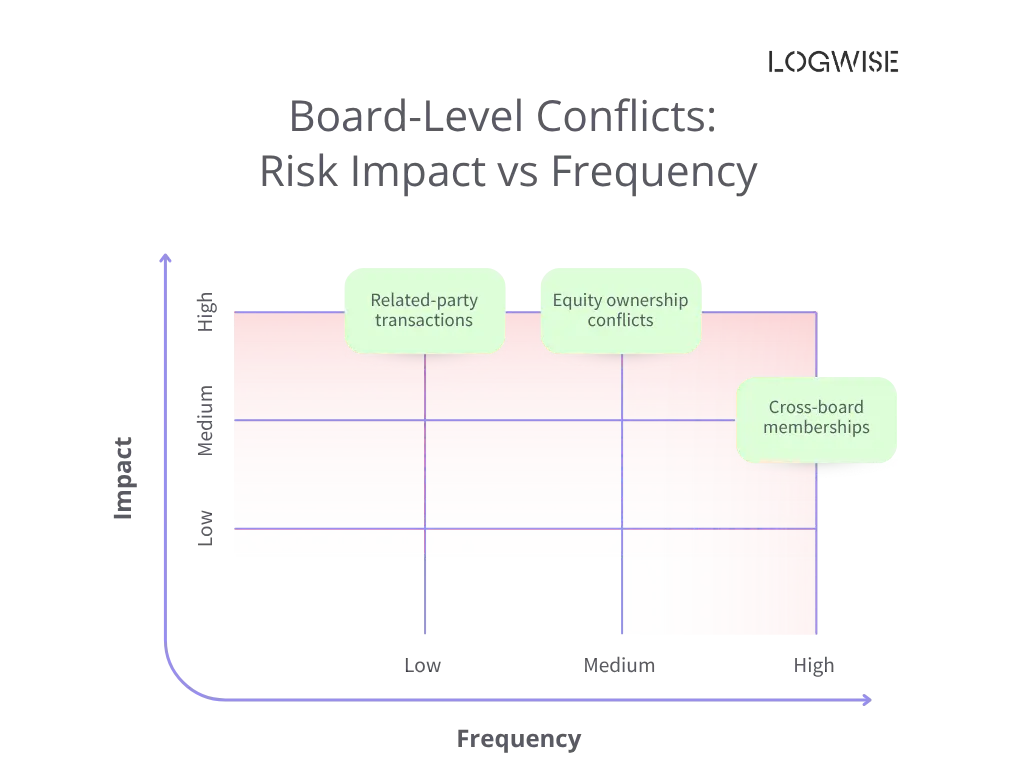
Board of Directors Conflict of Interest Examples
In order to illustrate the common conflicts of interest as described above, we have provided some different examples below, that show these conflicts can be financial, relational, or structural. Each requires careful handling but the general approach is the same: disclose the conflict, and then manage it (often by recusal or other steps).
- A director who owns a construction firm could be tempted to influence the board to choose his firm for the company’s new headquarters project. This is a direct conflict – his duty as director to get the best value for the company vs. his desire for profit for his own firm.
- If a director doesn’t recuse themselves and persuades the board to do business with a company they have a stake in, the terms might not be fair to the company. This could mean the company overpays or gets subpar service due to the director’s divided loyalty.
- If a board member in a real estate company learns of a prime land sale, they shouldn’t go buy that land personally without first offering it to the company. If they do, that’s a conflict and breach of duty. This is a bit different from a conflict involving a decision, but it is about a director’s personal interest conflicting with their duty to the company.
- If a board member of a telecom company also sits on the board of another telecom company, they would have to recuse themselves from any competitive strategy discussions, because they can’t serve two competitors’ interests at once.
- If a director owns part of a vendor or is invested in a business that the company might acquire or partner with. If the board considers a deal involving that entity, the director stands to gain financially beyond their role as a shareholder of their own company.
- If the company might be considering hiring a consulting firm for a project, and one of the board members’ spouses is a partner in that firm. Even if the terms are fair, this requires careful handling because it could be seen as favoritism or benefit to the director’s family.
Best Practices for Board Conflict of Interest Compliance
It is often advised to implement and follow a robust conflict of interest policy for board members, as soon as possible. This policy should define what constitutes a conflict for a board member, state the duty to disclose any actual or potential conflicts to the board and more.
As with employees, boards benefit from an annual disclosure process. Each director should fill out a questionnaire each year detailing, their and their immediate family members’ professional affiliations, any material financial interests in any entity that does business with or competes with the company, as well as close relationships and other relevant information.
Besides these best practices, managing board conflicts of interest effectively requires a combination of clear policies, thorough procedures, and a culture of transparency. The practices below are all typically implemented to varying degrees, depending on the specific structure and needs of companies.
Board Training and Orientation
This concept aims to ensure that new directors are briefed on their fiduciary duties and the conflict of interest policy during onboarding. Seasoned directors usually know the drill, but reiterating doesn’t hurt. Also, periodic refreshers on ethics at the board level can reinforce expectations.
Monitor Changes in Directors’ Circumstances
The company secretary’s team should keep an eye on any known changes that could trigger a conflict. Ideally, directors proactively inform the board of significant changes in their day jobs or new affiliations, but having a dialogue helps ensure nothing slips through.
Document Everything
From a compliance perspective, thorough documentation is vital to smooth operations. Keep that conflict of interest register up to date. Document disclosures and recusals in minutes. If a conflict is complex and requires legal opinions or independent valuations, keep those reports on record. Good documentation can defend the board if ever challenged.
Make Use of Technology and Tools
Employ board management tools or compliance software (like Logwise) to track and flag conflicts. A system that stores directors’ declared interests and can be referenced before meetings is extremely helpful. Logwise can compare the board’s interest list against, say, a list of major counterparties or even upcoming agenda items to highlight potential conflicts.
How Logwise Supports Board Conflict of Interest Management
Managing board conflicts can become complex, especially as companies grow and directors’ networks expand. Logwise offers solutions that specifically address the challenges of tracking and handling conflicts of interest at the board and executive level such as:
Pre-Trade Clearance for Insiders
Board members and senior executives are often subject to share trading restrictions. Logwise’s pre-trade clearance workflows can apply to them as well, ensuring compliance with insider trading laws and internal policies. Directors can submit their intention to trade company stock and get a compliance approval before proceeding.
Audit-Ready Conflict Reports
Some jurisdictions require formal conflict of interest registers and even submission to regulators – having it systematically tracked makes compliance with those requirements easier. With Logwise, come audit or regulatory inquiry time, generating a comprehensive report on board conflicts is straightforward.
Secure and Discreet Handling
Conflicts of interest, especially at board level, can be sensitive. Logwise provides a secure environment to handle these disclosures and workflows. Only authorized individuals (e.g. Compliance Officer, Company Secretary, maybe the General Counsel or Audit Chair) can see all the directors’ interest data. This confidentiality is important to encourage directors to be fully transparent without fear of broad exposure of their personal info.
Conclusion
It is necessary with a robust board of directors conflict of interest policy – as accomplished individuals will inevitably have other interests from time to time. But with solid policies, vigilant practices (like disclosure and recusal), and support from tools like Logwise, these conflicts can be navigated in a way that upholds the company’s best interests.

EU Listing Act – Implications for MAR and Insider Lists
 Compliance Regulations & Updates
The Act was published 14 November 2024 and entered into force on 4 December 2024. Its changes to MAR are rolled out in two waves, with three different effective dates: 4 December […]
 7 min
7 min May 27, 2026
 EU Listing Act – Implications for MAR and Insider Lists
The Act was published 14 November 2024 and entered into force on 4 December 2024. Its changes to MAR are rolled out in two waves, with three different effective dates: 4 December […]
 4 minMay 27, 2026
 EU Listing Act – Implications for MAR and Insider Lists – 4 December 2024
The Act was published 14 November 2024 and entered into force on 4 December 2024. Its changes to MAR are rolled out in two waves, with two different effective dates: 4 December […]
 3 minMay 27, 2026
 Revised Conditions for Delaying Disclosure
The delay mechanism (under Art. 17(4)) is retained, but one of the three conditions has been amended. The previous condition – that delay is “not likely to mislead the public” – is […]
 4 minMay 27, 2026
 Protracted Processes: Disclosure Only on the Final Event
Under the pre-June 2026 rules: Issuers have been required to disclose inside information arising at each intermediate step of a protracted process (such as e.g. ongoing merger negotiations, a capital raise, or […]