
 5 minutes
 2025-07-14
 Insights
The Market Abuse Regulation (MAR) was introduced to uphold market integrity by creating a framework that promotes transparency and prevents unlawful practices across EU and UK financial markets.
This article will examine the market abuse regulation monitoring requirements, focusing on what issuers need to know to stay compliant and protect their reputations.
What Is Market Abuse Regulation (MAR)?
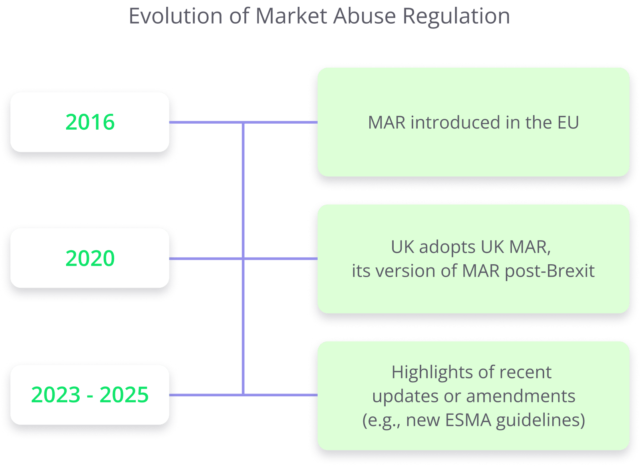
The Market Abuse Regulation (MAR), established in 2016, marked a pivotal moment for financial market regulation in the EU. This framework was introduced in response to growing concerns about market manipulation and insider trading, ensuring stricter oversight and harmonised rules across member states. It applies to all companies listed in regulated markets in the EU, Norway, and Iceland. Following Brexit, it has also influenced the UK’s regulatory framework.
The MAR regulation ensures that markets operate transparently and fairly, fostering confidence among investors. It addresses various issues, from maintaining insider lists to ensuring timely disclosure of material information, and imposes stringent requirements on issuers to prevent and detect market abuse.
Key Objectives of MAR
- Market Integrity: Prevent market manipulation and insider trading to ensure fair trading practices.
- Investor Protection: Foster confidence by promoting transparency and fairness.
- Regulatory Alignment: Provide a harmonised framework for issuers operating within the EU and UK.
- Global Standards: Serve as a model for similar regulations worldwide, ensuring consistency across markets.
Market Abuse Regulation Monitoring Requirements
The market abuse regulation monitoring requirements focus on proactive measures issuers must implement to detect and prevent abusive behaviours. These requirements are crucial for maintaining compliance and avoiding the severe sanctions associated with breaches.
Key Monitoring Obligations
- Insider Lists
- Issuers are required to maintain accurate and up-to-date insider lists. These lists identify individuals who have access to inside information and are crucial for tracking potential breaches.
- The European Securities and Markets Authority (ESMA Market Abuse Regulation) provides specific guidelines for maintaining and updating these lists. Ensuring these lists remain comprehensive is key to reducing regulatory risks.
- Disclosure of Inside Information
- Timely disclosure ensures that all market participants access material information equally, preventing unfair advantages.
- Issuers must also carefully manage disclosure delays, permitted only under specific circumstances outlined in the Market Abuse Regulation 2016. Clear documentation of the reasons for such delays is essential to avoid compliance issues.
- Suspicious Transaction and Order Reports (STORs)
- Issuers must establish systems to detect and report suspicious transactions or orders. STORs are submitted to national regulators to help identify potential market abuse.
- Proactive detection mechanisms supported by technology can improve the accuracy and timeliness of these reports.
- Employee Training and Awareness
- Regular training for employees, particularly those handling sensitive information, is critical for ensuring compliance with market abuse regulation monitoring requirements.
- Training should cover identifying inside information, understanding MAR Market Abuse Regulation obligations, and recognising suspicious activities. For instance, suspicious activities could include unusual trading volumes before a public announcement, repeated patterns of trades coinciding with undisclosed company news, or employees using encrypted communication to discuss sensitive topics.
European Market Abuse Regulation and ESMA’s Role
The European Securities and Markets Authority (ESMA) oversees the European Market Abuse Regulation. ESMA provides guidelines and technical standards to help issuers meet their obligations. Its directives include practical tools and processes for monitoring compliance, ensuring consistency across EU markets.
ESMA’s Key Contributions
- Guidelines for Insider Lists: Detailed requirements on the format and content of insider lists.
- Market Monitoring Tools: Resources to help issuers detect and report suspicious activities.
- Sanction Guidelines: Clear frameworks for penalties related to Market Abuse Regulation Europe breaches.
- Cross-Market Collaboration: Facilitating cooperation among member states to address cross-border regulatory challenges.
EU and UK Market Abuse Regulations: Key Differences
Post-Brexit, the UK introduced its version of the MAR framework, referred to as the UK MAR, which closely mirrors the EU Market Abuse Regulation MAR but with slight variations. Companies operating across both jurisdictions must know these differences to ensure compliance.
Key Differences
| Aspect | EU Market Abuse Regulation MAR | UK Market Abuse Regulation |
| Regulatory Body | European Securities and Markets Authority (ESMA) | Financial Conduct Authority (FCA) |
| Scope of Application | Applies across EU member states | Applies to UK-regulated markets |
| Reporting Standards | ESMA-driven | FCA-specific requirements |
| Cross-Border Coordination | ESMA facilitates collaboration | UK focuses on domestic enforcement |
Market Abuse Regulation Sanctions
Non-compliance with the market abuse regulation monitoring requirements can lead to severe penalties, including:
- Financial Fines: Substantial fines for issuers and individuals involved in breaches.
- Reputational Damage: Loss of investor trust and market confidence.
- Regulatory Scrutiny: Increased oversight and audits from regulatory authorities.
- Operational Disruption: Time and resources diverted to resolving compliance issues.
How to Comply with Market Abuse Regulation Monitoring Requirements
To ensure compliance with EU and UK Market Abuse Regulations, issuers should implement the following best practices:
- Develop Comprehensive Policies
- Establish clear policies outlining obligations under the MAR Market Abuse Regulation.
- Ensure these policies are accessible to all employees and regularly updated to reflect regulatory changes.
- Include specific protocols for handling inside information and responding to regulatory inquiries.
- Regular Training
- Conduct frequent training sessions to raise employee awareness about the market abuse regulation monitoring requirements.
- Include real-world scenarios to enhance understanding and application.
- Periodic assessments to gauge the effectiveness of training can help address knowledge gaps.
- Timely Reporting
- Establish systems for timely disclosure of inside information and suspicious activities.
- Assign dedicated compliance officers to oversee reporting processes and liaise with regulators.
- Proactive communication channels can ensure faster responses to emerging issues.
- Ongoing Monitoring and Audits
- Implement regular audits to evaluate the effectiveness of compliance measures.
- Continuous monitoring systems should be in place to detect anomalies in trading patterns.
- Feedback mechanisms can support continuous improvement in compliance practices.
Conclusion
The Market Abuse Regulation (MAR) is a cornerstone of financial market integrity, requiring issuers to adopt stringent compliance and reporting measures. Whether navigating the EU Market Abuse Regulation MAR or the UK’s equivalent, issuers must remain proactive to ensure compliance.
By staying informed of ESMA Market Abuse Regulation and FCA guidelines and fostering a culture of transparency, companies can effectively mitigate risks and maintain investor trust.
Ensure seamless adherence to MAR monitoring requirements with our advanced compliance platform – book a demo today.

EU Listing Act – Implications for MAR and Insider Lists
 Compliance Regulations & Updates
The Act was published 14 November 2024 and entered into force on 4 December 2024. Its changes to MAR are rolled out in two waves, with three different effective dates: 4 December […]
 7 min
7 min May 27, 2026
 EU Listing Act – Implications for MAR and Insider Lists
The Act was published 14 November 2024 and entered into force on 4 December 2024. Its changes to MAR are rolled out in two waves, with three different effective dates: 4 December […]
 4 minMay 27, 2026
 EU Listing Act – Implications for MAR and Insider Lists – 4 December 2024
The Act was published 14 November 2024 and entered into force on 4 December 2024. Its changes to MAR are rolled out in two waves, with two different effective dates: 4 December […]
 3 minMay 27, 2026
 Revised Conditions for Delaying Disclosure
The delay mechanism (under Art. 17(4)) is retained, but one of the three conditions has been amended. The previous condition – that delay is “not likely to mislead the public” – is […]
 4 minMay 27, 2026
 Protracted Processes: Disclosure Only on the Final Event
Under the pre-June 2026 rules: Issuers have been required to disclose inside information arising at each intermediate step of a protracted process (such as e.g. ongoing merger negotiations, a capital raise, or […]