
 7 minutes
 2025-07-14
 Compliance Automation
Given the complex nature of the regulations and demands of modern governance, companies risk non-compliance issues at higher rates when they do not use compliance software solutions that help streamline and simplify the workflow and internal processes. The consequences can be detrimental to the company’s health, potentially resulting in financial penalties, reputational damage, and a disruption of overall operations.
With hundreds of compliance software vendors in the market, selecting the right partner can be daunting. This article will serve as a practical buyer’s guide, helping compliance officers and procurement teams evaluate tools and vendors based on real-world needs and strategic goals, ensuring a reliable and future-ready compliance software solution that helps the company stay compliant with current regulations while also being flexible enough to handle updates down the road.
The Role of Compliance Software in Modern Governance
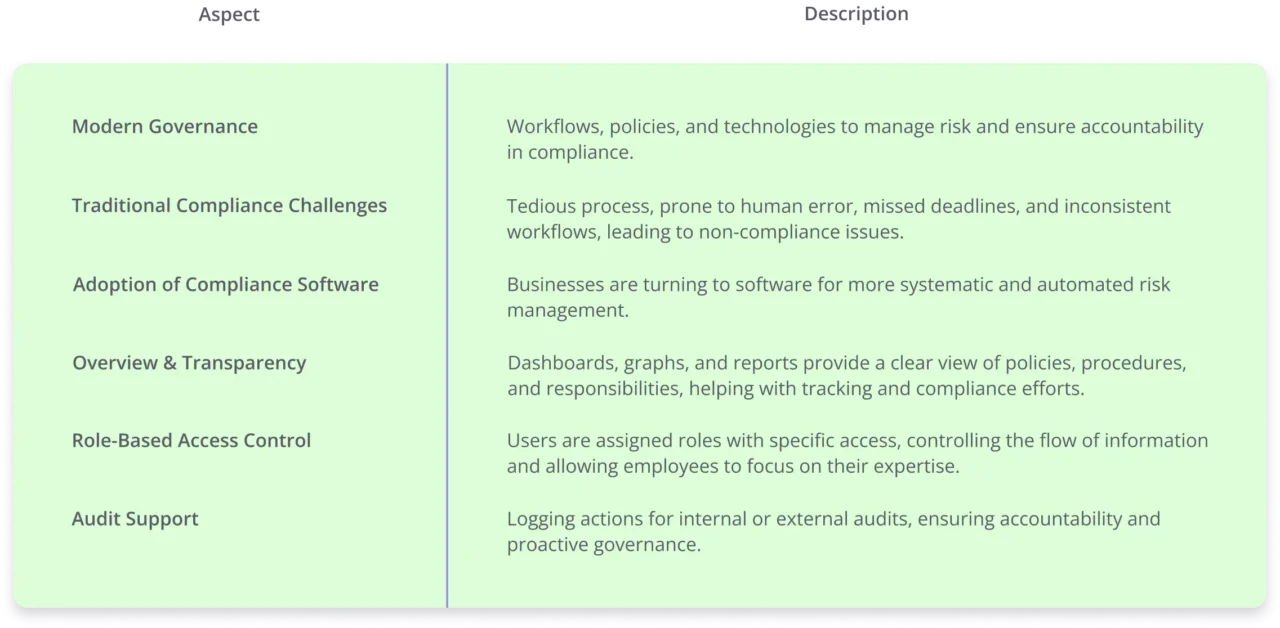
Modern governance encompasses a number of different areas such as the overall practices, policies and technologies used by companies to manage risk and ensure accountability in order to stay compliant, with regards to the industries and markets that the company operates within.
Traditionally handling compliance is not only a tedious process that requires constant management, documentation and oversight, it also leaves the company open to human error, missed deadlines and inconsistent use of company policies and workflows. All of which can potentially result in non-compliance issues.
With businesses required to adhere to an ever-growing number of regulations and an increased level of complexity, many are turning towards compliance software to manage these risks more systematically and even automatically.
These software platforms are able to provide a clear overview of the different policies, procedures, and responsibilities of the organisation, with dashboards, graphs, and reports that make it easy for employees and management to access data and track compliance efforts and results.
Users can be assigned different roles, which allows for specific access control for each individual employee, thus controlling the flow of information automatically, while still enabling the personnel to work within their designated areas of expertise.
Compliance software systems also help businesses when it comes to audits, whether internal or external, as every action within the system can be logged. This allows companies to hold employees or specific departments accountable for meeting compliance standards as necessary, resulting in a higher level of proactive governance.
Many platforms also include a number of tools designed for risk management, where it becomes easy to identify gaps in compliance before they grow into larger issues. These tools also provide a systematic approach to evaluating risks, allowing companies to prioritise which risks to address first, based on actionable data.
To summarize the role of compliance software in modern governance, the table below highlights its core features and advantages:
Key Evaluation Criteria for Finding the Best Compliance Software
Choosing the right compliance platform requires some planning and thought, as it should not only fit the company’s current operations, but also be flexible enough to scale with future growth or expansion into new markets, as well as being able to adapt to new regulatory frameworks.
Therefore, each company will have a different set of key criteria that applies. However, there are also some criteria revolving around core functionality that are practically universal, as they should be supporting the essential compliance process relevant to the specific industry of the company.
Specific features could in these cases include the ability to manage policies and procedures, automating workflows for compliance tasks and approvals, while providing audit trails, version control and reporting tools to help with transparency and accountability. Most companies will also benefit from having access to risk assessment and incident tracking tools.
Another common feature would be integration capabilities, allowing the compliance software to connect with existing internal systems and infrastructure within the company makes it possible to automate data transfers, generating reports and more, increasing the efficiency and supporting collaboration on a larger scale.
Other key criteria to consider would be the ability for the software to scale with future growth and expansion, as well as adapting to new regulatory requirements. Software that is able to support new markets and industries, as well as allow for an unlimited number of employees and internal departments are great candidates in these cases.
Finally, it is also worth mentioning the aspect of user experience and accessibility. The platform should be easy to use for the vast majority of employees, in order to ensure adequate adoption and consistent use of the software. While onboarding and training will help employees learn the platform, choosing a solution that is intuitive and user-friendly will make it much more likely to be a success.
Vendor Due Diligence Checklist
Once a list of criteria has been established, the next step when it comes to choosing compliance software is finding a suitable vendor that offers a solution with the necessary features. When looking at the different options, it is also a good idea to consider the vendor in terms of what they can offer outside of the technical aspects.
Industry experience can be one of the determining factors when evaluating different vendors, as companies with a deep knowledge of the sector are more likely to deliver a solution that aligns with the compliance needs, integrates smoothly with existing systems and infrastructure, while also providing support and advice that are relevant to the specific market and industry throughout the process.
Data security is another key factor to consider, especially for companies operating within certain sectors or geographical regions. When looking at the top compliance software companies, consider how they store the data, whether there are any recovery protocols in place, and whether they follow any recognised standards such as ISO, GDPR, and so on.
Key Questions for Vendor Evaluation and Product Demos
It should already be possible to narrow down the available vendors to a shortlist of the most promising ones. Whether through a series of product demos, talks with sales reps, or simply browsing vendor websites, asking some key questions can help uncover how well each platform and vendor fits the specific needs of a given company.
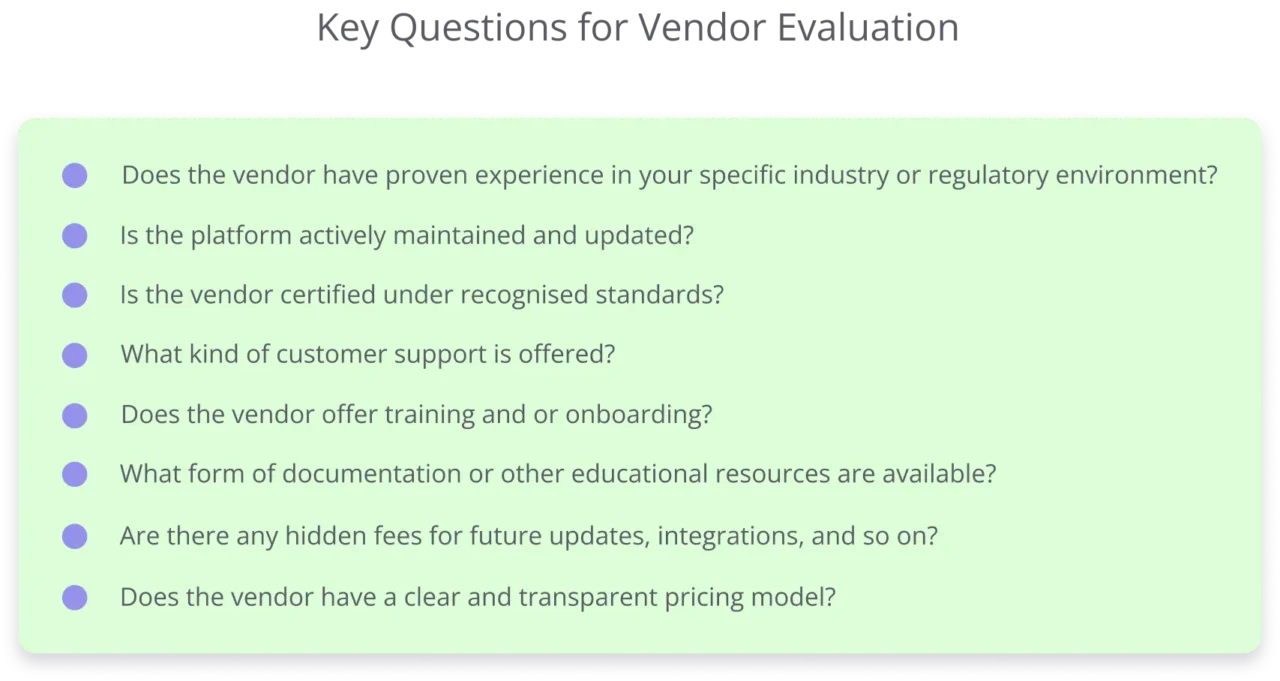
While not every question will be relevant to every organisation, these questions serve as a general guide to help narrow down which areas or features might be prioritised. The answers provided by the vendor will also help establish an idea of trustworthiness, expertise and experience.
Proven Success by Logwise
Logwise compliance software solutions are used by some of the leading organisations across all of Europe, as our user-friendly platforms are built on years of experience and designed for the actual compliance challenges companies across a range of different industries and sectors face on a daily basis.
We do not build our solutions in isolation either. Instead, we focus on designing top compliance software in direct collaboration with our clients. We draw from real use cases and feedback to continuously enhance our products, thus providing solutions used in heavily regulated industries such as banking, insurance, healthcare, logistics, and more.
Whether navigating compliance with regards to GDPR, financial conduct, ESG reporting or internal governance standards, our solutions provide a reliable system that provides both the flexibility and confidence needed to stay ahead of the competition while avoiding non-compliance issues.
Conclusion
Staying ahead of the regulatory requirements, adapting to new scenarios, and managing internal policies, employees and workflows can be challenging, even at the best of times. Adopting compliance software can make a significant difference, as it helps streamline the complex processes, reduces human errors, and helps companies stay proactive when it comes to non-compliance.
By choosing an experienced software vendor with a proven track record and the necessary expertise, compliance software can become a differentiating factor in terms of competition, growth and long-term sustainability.
Looking for a reliable, scalable compliance solution? Book a demo with Logwise and see how our platform meets your regulatory needs.

EU Listing Act – Implications for MAR and Insider Lists
 Compliance Regulations & Updates
The Act was published 14 November 2024 and entered into force on 4 December 2024. Its changes to MAR are rolled out in two waves, with three different effective dates: 4 December […]
 7 min
7 min May 27, 2026
 EU Listing Act – Implications for MAR and Insider Lists
The Act was published 14 November 2024 and entered into force on 4 December 2024. Its changes to MAR are rolled out in two waves, with three different effective dates: 4 December […]
 4 minMay 27, 2026
 EU Listing Act – Implications for MAR and Insider Lists – 4 December 2024
The Act was published 14 November 2024 and entered into force on 4 December 2024. Its changes to MAR are rolled out in two waves, with two different effective dates: 4 December […]
 3 minMay 27, 2026
 Revised Conditions for Delaying Disclosure
The delay mechanism (under Art. 17(4)) is retained, but one of the three conditions has been amended. The previous condition – that delay is “not likely to mislead the public” – is […]
 4 minMay 27, 2026
 Protracted Processes: Disclosure Only on the Final Event
Under the pre-June 2026 rules: Issuers have been required to disclose inside information arising at each intermediate step of a protracted process (such as e.g. ongoing merger negotiations, a capital raise, or […]